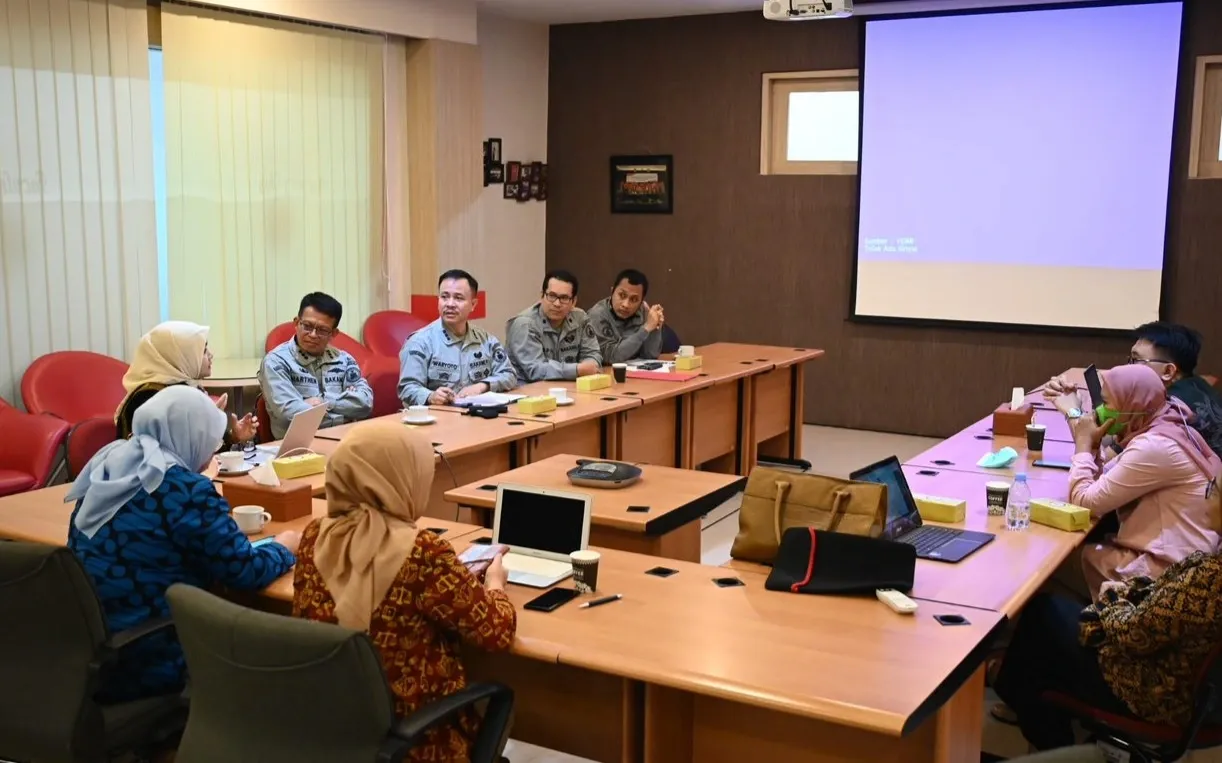
Strengthen Collaborative of Inter-Institutional Researchers, Directorate of Research and Development BAKAMLA Visits FH UNAIR

On Thursday (2/3/2023), the Department of International Law FH UNAIR visited researchers from the Maritime Security Agency (BAKAMLA), Col. Bakamla Ir. Marthen Pendi., Col. Bakamla Waryoto, S.E., May Bakamla Aspin Utoyo, S.Kom., and First Lieutenant Bakamla Moch. Chairul Anam, S.T. in the Faculty Club Room. The researchers from the Republic of Indonesia’s maritime security team visited intending to strengthen institutional cooperation between research institutions and hoping for advice in academic studies to realize security, safety, and law enforcement practices in marine matters in Indonesia.


In this meeting, the Department of International Law FH UNAIR, represented by Professor of International Law Prof. Koesrianti, LL.M., Ph.D. accompanied by the Director of Airlangga Institute of International Law Studies (AIILS) Mr. Adhy Riadhy Arafah., LL.M. (Adv.) along with experts of International Law and Maritime Law Mrs. Dr. Aktieva Tri Tjitrawati., Mrs. Dr. Nilam Andalia Kurniasari., LL.M and Mrs. A.Indah Camelia., S.H., M.H


FH UNAIR was chosen because it is one of the law campuses with the best research on Law of the Sea in Indonesia, with research that was carried out long ago by research academics before the appearance of Government Regulation Number 13 of 2022 concerning the Implementation of Security, Safety and Law Enforcement in the Waters Indonesia. The corporation is expected to conduct a series of scientific activities to produce an in-depth understanding and develop the practical application of in-depth scientific values and contexts or appropriate methods for implementing maritime security.


This visit was wrapped in the Model Forum Group Discussion (FGD) and reaped various reciprocal responses to the solutive arguments in this joint dialogue. Suggestions in the form of implementation of maritime security, safety, and law enforcement, hope in the form of various research models that can be used so that later this research can become a reference which in its implementation can be carried out correctly.


The Department of International Law FH UNAIR expressed readiness to have resources to assist BAKAMLA in carrying out some of the urgent needs of BAKAMLA, one of the inputs that can be given is the need for cooperation from each Stakeholder who is responsible for implementing policies on safety and law enforcement.


This meeting will later become the foundation for the collaborative relationship between the two institutions, BAKAMLA and FH UNAIR to enforce national policies on maritime security, safety, and law enforcement in Indonesia. Whether it’s in the framework of Evaluation, Suggestions and Input to coordinate and synchronize the aspects of the law of the sea in Indonesia. Therefore, the Department of International Law FH UNAIR hopes that there will be in-depth studies carried out by BAKAMLA Researchers so that they can identify every sector of crime at sea.


In closing, UNAIR Faculty of Law wholeheartedly stated that they are willing to collaborate with the Directorate of Research and Development Bakamla within the scope of Higher Education’s Tridharma, namely Education and Teaching, Research and Development and Community Service.

AIILS FH UNAIR Discusses Unruly Passenger Provisions and Possible Ratification of the 2014 Montreal Protocol

Everyone undoubtedly wants a safe and comfortable flight when traveling by airplane. Each airline, of course, also has its standards to provide the best experience to its passengers equally, so they feel comfortable. However, it cannot be denied that disturbances in the form of violations committed by other passengers will disturb comfort. This is the background for the emergence of international and national legal provisions against passengers who do not comply.


To learn more about the legal provisions for non-compliant passengers, the Airlangga Institute of International Law Studies (AIILS) Study Center, Faculty of Law, Universitas Airlangga (FH UNAIR). The webinar, held on Wednesday, December 7, 2022, had the theme “Unruly Passenger and the 2014 Montreal Ratification for Indonesia”. This activity also invited Dhony Vasmin Akhsomo, S.T. (Surabaya Region III Airport Authority Office), Dr. Endang Puji Lestari, S.H., M.H. (Surabaya Region III Airport Authority Office), as well as Adhy Riadhy Arafah, S.H., LL.M. (Adv) (Director of AIILS FH UNAIR) as the speaker.


Dhony Vasmin Akhsomo, S.T., who was lined up as the first speaker, had the opportunity to deliver material from a technical point of view of procedures for handling passengers. He explained that his job as a flight instructor must be in direct contact with other aircraft operation support personnel, so he must have a technical background to support work in the field. In simple terms, he then explained that the term unruly or disruptive passenger is the behavior of passengers who are unable to obey the rules on the plane or do not follow the flight crew’s instructions that it disrupts order and discipline on the aircraft. The regulations regarding unruly passengers are regulated in the provisions of ICAO Annex 6 (Aircraft Operation), ICAO Annex 9 (Facilitation), ICAO Annex 17 (Security), ICAO Circular 288, ICAO Doc 10117, ICAO Doc 10002, Law Number 1 of 2009, Minister of Transportation Regulation Number 61 of 2015, Minister of Transportation Regulation 51 of 2020, and Minister of Transportation Regulation Number 35 of 2021.


The next opportunity was given to Dr. Endang Puji Lestari, S.H., M.H. as the second speaker. He said that the fundamental provisions regarding general aviation were initially regulated in the 1944 Chicago Convention. Indonesia has ratified several international regulations regarding public aviation since 1976. However, the 2014 Montreal Protocol has just been ratified. Efforts to confirm it has been made since 2017 through various activities such as focus group discussions. “So currently, it is actually in the ratification process because there are several clauses that have not been regulated in our law,” he explained.


Submission of material then continued to Adhy Riadhy Arafah, S.H., LL.M. (Adv) as the last speaker. He stated that it was confirmed that Indonesia had ratified the 1963 Tokyo Convention, The Hague Convention of 1970, and the 1971 Montreal Convention through Law Number 2 of 1976. Meanwhile, the 2014 Montreal Protocol had yet to be ratified by Indonesia. The 2014 Montreal Protocol itself is intended to improve and replace the 1963 Tokyo Convention, which still has loopholes. According to him, Indonesia itself is still hindered by several challenges to ratifying the 2014 Montreal Protocol because there is a tendency to avoid lengthy processes in the House of Representatives and make changes to Law Number 1 of 2009 concerning Aviation. According to him, the ratification of the 2014 Montreal Protocol does not have to be in the form of a law; it is enough with a Presidential Regulation with the consideration that the ratification of the 1963 Tokyo Convention at that time had already ratified three conventions in one law at once. In addition, currently, Indonesia already has Law Number 24 of 2000 Concerning International Agreements, which provides guidelines for ratifying international agreements in Articles 10-11.

AIILS FH UNAIR Discusses Cyber Crime from a Juridical and Technical Perspective to Enrich Student Perspectives

Crime in cyberspace has become increasingly widespread these days. The Bjorka case that occurred throughout 2022 illustrates how vulnerable cyberspace is to attacks and crimes. Cybercrime can be committed from anywhere. It is also known as a transnational crime within the country and abroad. This later became the background for Airlangga Institute for International Law Studies (AIILS) to hold an open discussion again on Friday, 11 November 2022. The title raised at the activity was “Questioning the Jurisdiction of the PDP Law vs. the ITE Law: Problems and Challenges in the Digital Age”.


Present as resource persons from student elements at the activity were Nenes Renata, a student at the Faculty of Law, Airlangga University, and Fachry Dwi Handoko, an Information Systems student at the Sepuluh Nopember Institute of Technology. Also present was Masitoh Indriani, S.H., LL.M. , a cyber law expert at the Faculty of Law, Airlangga University, to respond to the discussion. The discussion was opened directly by Adhy Riadhy Arafah, S.H., LL.M. (Adv.), as the Director of Airlangga Institute for International Law Studies (AIILS). He hopes that this meeting in the future can result in closer collaboration between the Faculty of Law, Universitas Airlangga, and the Sepuluh Nopember Institute of Technology, especially from the student side.


Then, Nenes Renata had the first opportunity to present her argument from a legal perspective. According to her, it is at least necessary to understand the jurisdiction first in dealing with transnational crimes. Based on the legal provisions in the ITE Law and the PDP Law, all legal actions that harm Indonesia’s interests fall under the jurisdiction of the Indonesian state under the objective territorial principle. Nonetheless, the two have essential differences. The jurisdiction in the ITE Law only requires that legal consequences only occur in Indonesia. Whereas in the PDP Law, this jurisdiction was again expanded to protect data subjects of Indonesian citizens abroad. However, whether cyber crimes that occur abroad can indeed be tried in Indonesia is still a question. In answering this question, it is at least necessary to know Indonesia’s readiness to carry out Mutual Legal Assistance and extradition.


Fachry Dwi Handoko then continued by examining the Indonesian government’s infrastructure’s readiness to respond to cyber crimes. According to him, cyber crimes do not recognize the boundaries of state jurisdiction and are sometimes carried out anonymously. Hackers often easily understand the weaknesses and loopholes in the cyber infrastructure in Indonesia. This is proven by the Bjorka case, the Tokopedia case, and even the final voter list for the 2014 general election. The various ways that are usually carried out in cybercrime in the form of hacking are using SQL Injection techniques and distributed denial-of-service (DDoS) attacks.


Regarding the discussion, Masitoh Indriani, S.H., LL.M., then provide feedback. According to her, at least the direction of the conversation tends to lead to cyber security aspects, with a tiny element in it being cybercrime. The discussion has also illustrated law in Indonesia already exists as a means or tool to ensnare criminal acts on the internet. However, the main problem is whether cyberspace can be measured and its boundaries between countries known because of its invisible nature but its influence can be felt. This shows that law is an essential aspect in the cyber context, but it is also an important technical aspect of translating existing technology. “Whatever the type of cybercrime, what is certain is that it is true, disturbing, and detrimental to all of us,” she explained. In the context of cyber security, at least three elements must be protected, namely infrastructure, information security, and individual security. “Then the next job for all of us is what should Indonesia do next?” she said in closing.

UNAIR Faculty of Law Commemorates Human Rights Day with a Seminar on the Marginalization of the Ahmadiyya Congregation in Indonesia

Human Rights Law Studies FH UNAIR and Center for Legal Pluralism Studies (CLeP) FH UNAIR collaborate in a series of Human Rights Day events held every Thursday. This activity was carried out to celebrate International Human Rights Day, which is celebrated every December 10.


The third event was a seminar entitled “Reviewing Religious Minorities from a Human Rights Perspective: Indonesian Ahmadiyya Congregation (JAI)”. Two speakers were invited to the symposium. The first is JAI Spokesperson and Press Secretary Yendra Budiana. Yendra explained that the Ahmadiyya Congregation had actively participated in the struggle for independence and had been recognized as a post-independence socio-religious organization.


“Many of the heroes and figures who have contributed to the advancement of the Indonesian state are Ahmadiyah followers. For example, W.R. Soepratman, Arief Rahman Hakim, and badminton athlete Olich Sholihin. But the bad perception and marginalization of us started even after the Reformation era rolled around, strangely there,” said Yendra.


Yendra told various kinds of discrimination and violence faced by members of JAI. They were starting from the issuance of SKB 3 Ministers, which limited religious activities and then interpreted in the regions to limit their administrative rights. Until the sealing and destruction of the mosque to the murder of 3 JAI members in Cikeusik, Banten.


“Although it has subsided in recent years, it does not mean that marginalization does not exist. This hatred is nourished through misperceptions regarding our interpretation of Islam. Starting from being considered a prophet, not the Prophet Muhammad SAW, his book is not the Koran, until his creed is different,” said the spokesperson.


The second speaker was Director of CLeP FH UNAIR Joeni Arianto Kurniawan, Ph.D. Joeni said that violence in the name of religion in Indonesia often occurs due to strengthening fundamentalism, primarily Islamic or Islamism. The political agenda of this Islamism seeks to turn Indonesia into an Islamic state, or at least an application of shari’a that conforms to their formal interpretation of the law.


“In some cases, they succeeded. The discriminatory SKB 3 Ministers is just one example. Even Article 28J paragraph (2) in the 1945 Constitution of the Republic of Indonesia is a successful form of the Islamism agenda. In the article, human rights in Indonesia can be limited by religious values,” said the expert in law and religion.


According to Joeni, this constitutional basis paved the way for laws to formalize the interpretation of Islamism. Take the PNPS Law 1/1965 as an example, famous for using rubber articles related to blasphemy to marginalize religious minority groups. The Constitutional Court defends its existence because the legislation is considered the embodiment of Article 28J paragraph (2) of the 1945 Constitution of the Republic of Indonesia.


“For this reason, the law needs to be changed in Indonesia so that the pretext of religion is not given way to discriminate against or marginalize certain groups. This requires an intercultural approach, in which law can become a bridge so that all religious groups (including non-religious ones) can practice their beliefs and get to know each other. Remember the saying, you don’t know what you don’t love,” concluded Joeni.

International Human Rights Day Commemoration Events at FH UNAIR

Human Rights Law Studies (HRLS) FH UNAIR, Center for Legal Pluralism Studies (CLeP) FH UNAIR, and Amnesty International Indonesia Chapter UNAIR collaborated to hold a series of events to commemorate International Human Rights Day. The commemoration is held every December 10. Titled “Embracing Humanity, Celebrating Diversities”, the activity is held for three weeks every Thursday.


At the peak of the event on Thursday (1/12/2022), four activities were held in one day. In the morning, a seminar was held that discussed the marginalization of the Indonesian Ahmadiyya Congregation (JAI) in Indonesia during the Reformation era. JAI Spokesperson Yendra Budiana was invited as a guest speaker and Director of CLeP FH UNAIR Joeni Arianto Kurniawan, PhD.


“We experience various kinds of discrimination because of the strong misperception that we are not Muslims. Starting from the issuance of the SKB of 3 Ministers, which restricted our worship, restricted administrative rights, destroyed the mosque, to the murder of 3 of our congregations in Cikeusik, Banten,” said Yendra.


The second activity that was held was a student debate and free speech on the theme “Is Recognition of LGBTQ+ Rights in Indonesia Necessary?” The debates on the pro side came from research assistants HRLS FH UNAIR and CLeP FH UNAIR, while the contras came from elements of the Islamic Spiritual System (SKI) FH UNAIR.


Arguments from the pro side emphasize that LGBTQ+ rights are a form of rights that cannot be separated from human rights. The limitation and negation of these rights in Indonesia are due to the rise of political homophobia, which experienced intensification after the New Order. On the cons side, limiting LGBTQ+ rights in Indonesia makes sense because Indonesian law only recognizes the form of marriage between a man and a woman. Not only that, LGBTQ+ is emphasized as a form of deviance. However, the opposing party does not agree with any form of discrimination or violence aimed at the LGBTQ+ group.


The third activity of the day was an audiovisual art exhibition. Works ranging from paintings and photography to short films are displayed in Building C FH UNAIR. UNAIR Amnesty Chapter Coordinator Dhamar Jagad Gautama said that what was shown there contained various social criticism related to the lack of efforts to uphold human rights in Indonesia.


“Starting from taking pictures of Amnesty friends when they visited Wadas Village, whose hill was to be turned into a mine. The rise of sexual violence and patriarchal culture in Indonesia. The stronger the oligarchy in suppressing the rights of the common people. So, a short film about land conflicts in Tambak Bayan, Surabaya,” said the UNAIR FH student.


The day was closed with an art pulpit held in the evening. Various kinds of performances were present at the pulpit. From poetry readings about human rights violations in LGBTQ+ conversion therapy, and hip-hop songs related to Surabaya, to theatrical actions about human rights violations during 1997-98 in Indonesia.

HRLS FH UNAIR Presented a Documentary Movie and Discussion on Missing UNAIR Students in 1998

Human Rights Law Studies (HRLS) FH UNAIR and Center for Legal Pluralism Studies (CLeP) FH UNAIR collaborate in holding a series of Human Rights Day events which are held every Thursday. This activity is held to celebrate International Human Rights Day, which is celebrated every December 10.


The second program is documentaries about Herman Hendrawan and Bimo Petrus (Bimpet). This activity was held on Thursday (24/11/2022). This documentary is an episode of Fighting Forgotten, a TV show that aired on Metro TV. Herman and Bimpet are UNAIR Faculty of Social and Political Sciences (FISIP) students who were victims of enforced disappearances from a series of disappearances of 13 activists in 1997-98.


The political context when the tragedy occurred was that Indonesia was entering the end of the New Order regime when Suharto’s authoritarian and militaristic power began to falter. Movements such as the People’s Democratic Party and the Indonesian Students’ Union for Democracy, in which Herman and Bimpet actively participated, began to demand massive democratization and the abdication of Suharto from the presidency.


Two key persons were invited to discuss the tragedy. The first is the East Java Association of Families of Missing Persons (IKOHI) Dandik Katjasurkana. While Dandik was a student, he was a comrade in arms of Herman and Bimpet in the pro-democracy movement. In his presentation, he recalled the nature and experience of his interactions with the two. Dandik also explained their struggle for commemoration after the Reformation era.


“In the early 2000s, we tried persuasion from the FISIP UNAIR dean and were encouraged to build a memorial statue for Herman and Bima. However, it is challenging and, until now, has not been realized. The reason is that their disappearance was due to political events. This is funny, even though enforced disappearance is a humanitarian issue, even though political issues triggered it,” said the activist.


Dandik also said it was important always to discuss and remember events related to enforced disappearances. This is because impunity is still thick in these cases, while the alleged perpetrators are still in the government’s circle of power until now.


The second guest speaker was UNAIR History Student Habi Sjarif. Habi said that one of the New Order policies whose impact is still being felt today is the depoliticization of universities. Through the Normalization of Campus Life/Student Coordinating Body (NKK/BKK) policy in 1978, students were prohibited from participating in political activities, and state and military elements quickly entered and controlled the campus.


“Herman and Bimpet’s resistance based on populist politics is a form of resistance from the NKK/BKK; therefore, the regime considers them a threat. Even though the NKK/BKK is no longer enforced, the campus’ habit of being blind to humanitarian issues and its closeness to authorities can still be felt and taken on new forms,” said the 2018 batch student.

MPR RI Research Center & Constitutional Law & Governance Studies Faculty of Law UNAIR Conduct Studies on State Institution

The changes in the 1945 Constitution from 1999 to 2022 have changed the Indonesian constitutional system. Starting from shifting the concept of people’s sovereignty which has implications for the implementation of sovereignty which no longer places the MPR as the highest state institution, strengthening the presidential system and strengthening the separation of powers, the presence of new institutions such as the MK and KY, to the mechanism for dismissing the President. The new state administration practice after the amendment to the 1945 Constitution needs to be reflected and evaluated. For this reason, the RI MPR Study Agency collaborated with the Center for Constitutional and Governance Studies (PSKK) to conduct a State Institutional Study. The Faculty of Law, Airlangga University, worked an FGD on the issue of State Institutions and Relations between State Institutions, in Surabaya, on 25 November 2022.


Drs. Agun Gunandjar Sudarsa. Bc.IP., M.Sc, member of the MPR and an experienced politician, was involved in the amendments to the 1945 Constitution in 1999-2004. It was also attended by 2 Indonesian MPR and the Review Board members, namely H. Johan Rosihan, ST., and Slamet Ariyadi, S.Psi,. The participants who attended were lecturers and researchers affiliated with the Center for Constitutional and Governance Studies at the Faculty of Law, Airlangga University, such as Dri Utari C.R., LL.M, Dr. M. Syaiful Aris, Dr. Rosa Ristawati, PSKK fellow from BRIN, Otto Trengginas and several others.


In his introduction, Mr. Agun Gunandjar Sudarsa stated that the Assessment Body needs views and input from academics who are free to convey their thoughts and ideas regarding state institutions. This FGD has ten sub-themes relevant to the issue of state institutions, such as the position of the KY, the DPR’s approval function in public office, DPD participation mechanisms in legislation, state involvement in changes to the 1945 Constitution, and other themes. In this FGD, all participants actively explained each appropriate sub-theme and received responses from the members of the Assessment Body. The discussion took place interestingly on actual issues, such as the problem of removing MK judges.


Dr. Radian Salman, Chairman of PSKK expressed his gratitude for the several times the MPR Review Board has given the trust to this collaboration and hopes that PSKK can contribute through FGDs whose output is in the form of articles that will be published in the Jurnal Majelis.

Examining the Rights of Marginalized Indigenous Peoples by the IKN Megaproject in the HRLS x CLeP Webinar

Human Rights Law Studies (HRLS) FH UNAIR and Center for Legal Pluralism Studies (CLeP) FH UNAIR collaborate in holding a series of Human Rights Day events every Thursday. This seminar was held to celebrate International Human Rights Day on December 10.


The first series of discussions was on Thursday (17/11/2022), titled  “Exploring Indigenous Peoples in the Protection of Human Rights in the Context of Development of the IKN vs. Realization of the 2045 Economy.” UNAIR FH student Anna Maria was invited to be a speaker at the discussion.


Anna said that the rights of many indigenous peoples were marginalized in the development of the IKN megaprojects. This is because the project location has a lot of contact with Adat lands, and the development process and the formulation of legislation (Law 3/2022 concerning the State Capital) do not involve the participation of local indigenous peoples.


“In fact, in Article 18B paragraph (2) jo. Article 28I paragraph (3) of the 1945 Constitution of the Republic of Indonesia guarantees constitutional recognition of the rights of indigenous peoples. However, the embodiment of legal politics in statutory regulations is often minimal and is often overshadowed by the government’s desire for massive economic growth. This IKN megaproject is one of them,” said the Inspector General of MYMA FH UNAIR.


Anna said recognizing indigenous peoples’ rights is still sectoral in Indonesian law. For example, her acknowledgment of Adat forest affairs in the Forestry Law and Decision Number 35/PUU-X/2012 strengthens the position of rights to Adat forests. However, no law explicitly regulates indigenous peoples. Anna added that the Indigenous Peoples Bill still needs to be passed by the DPR, showing the landscape lacks the political will to recognize the rights of indigenous peoples.


Anna’s presentation was then responded to by Joeni Arianto Kurniawan, Ph.D, the Director of CLeP FH UNAIR. Joeni explained that indigenous peoples need special protection because of their vulnerability, especially in Adat land matters. He added that the landscape of land regulations in Indonesia in the Basic Agrarian Regulation Law still suppresses the rights of indigenous peoples.


“So the recognition of Adat land is limited to not contradicting national interests. Adat land ownership by indigenous peoples was long before Indonesia existed. The recognition of the rights of indigenous peoples in Indonesia is still confusing and half-hearted,” said the Customary Law expert.


Joeni said that the fundamental problem in the IKN megaproject is the absence of Free, Prior, and Informed Consent (FPIC) implementation. The application of FPIC to indigenous peoples is necessary, namely, when the state asks indigenous peoples whether their land is allowed to be used for a project. Thus, indigenous peoples are given space for free and informed participation and consent.


“This is because indigenous peoples have the right to self-determination, including utilizing and determining the fate of the customary land they own. So this right should not be misunderstood as a door for separatism; this is the collective autonomy of a society,” concluded Joeni.

September 30 Movement and Its Today Legacy

The end of September to the beginning of October is the darkest period in the history of Indonesian. Every September 30, various calls appear to fly the red and white flag at half mast and raise it to one mast on October 1. This was motivated by a movement in the early hours of September 30, 1965, which later killed six generals and one officer of the Indonesian National Army. However, the atrocities did not stop there because the events that followed were far more violent for a very long time and had more victims.


The Center for Legal Pluralism (CLeP) and Human Rights Law Studies (HRLS) of the Faculty of Law Universitas Airlangga were discussed the September 30 Movement last Monday, October 3, 2022. The discussion was aimed to reflect the mass killings in 1965-1966 as serious human rights violations that have not yet come to light in providing a just settlement for the victims and their families.


The public discussion entitled “The 65 Incident and Prospects of Justice for Past Serious Human Rights Violations”. The discussion was held in a hybrid manner on Monday, October 3, 2022, and presented Pradnya Wicaksana as Research Assistant of CLeP FH UNAIR to discuss what happened at that time and its impact until now.


The activity was opened by E Joeni Arianto Kurniawan, S.H., M.A., Ph.D., as Director of CLeP FH UNAIR. In his remarks, he said that discussions like this were routine between the Center for Legal Pluralism (CLeP) and Human Rights Law Studies (HRLS), especially in reflecting on the sacred day of Pancasila. Instead of following the flow of mainstream history in Indonesia, through this discussion, the two study centers tried to deconstruct the existing historical narrative and try to explore more about September 30 Movement. According to him, September 30 Movement can be called our darkest period in Indonesian history. The September 30 Movement was one of the darkest historical periods in our journey as a nation. It has cost the lives of at least 500,000 Indonesians without any judicial process. He hopes law enforcement against incident 65 can be a decisive milestone in addressing human rights crimes in Indonesia, especially in the past through ad hoc human rights courts.


As a discussion starter, Pradnya, a student of the Faculty of Law, Universitas Airlangga, started his presentation by telling the background of the September 30 Movement. According to him, the events on September 30, 1965, occurred because of the political dynamics of the unstable guided democratic regime. This is considering that at that time, Soekarno tried to unite the three major political forces, namely, nationalists, religious, and communists. Moreover, at that time, the communist movement in Indonesia was the third largest in the world after the Soviet Union and China. This condition was then exacerbated by various issues such as the discourse on the formation of the fifth generation, the confrontation between Malaysia and the struggle for West Irian, the cold war with its Truman doctrine, and the economic crisis. The facts that are genuinely illustrated by September 30 Movement include that six Army Generals and one Army Officer were kidnapped and killed,  accompanied by the occupation of the Radio Republik Indonesia office and a declaration. Nevertheless, the event still leaves a lot of mystery because there is no historical consensus regarding who and what the intentions of the event were, giving rise to various speculative theories.


This incident led to scapegoat propaganda to weaken Soekarno’s position to discredit the regime. This propaganda resulted in the emergence of a conspiracy that made the communist movement a scapegoat to legitimize the political purge of members of the Indonesian Communist Party (PKI) and Soekarno loyalists. This seems to have led to a genocide that killed 500,000 – 3,000,000 people consisting of PKI members, members of PKI affiliated organizations (Gerwani, Lekra, etc.), suspected PKI sympathizers, Soekarno loyalists, Abangan Muslims, atheists, and ethnic Chinese. The portraits of the atrocities that occurred include Non-Mechanized Violence in the form of cold-blooded killings to erase people with ideologies or suspected of having certain ideologies to their roots, sexual violence in the form of mass rape, nudity, sexual torture, etc. as a form of propaganda related to Gerwani’s immorality, and detention. Politics for those who are not directly affiliated without a judicial process (extrajudicial detention). The various propaganda and portraits of this abomination can still be felt in Indonesian society, such as historical impunity and censorship, anti-communism identity politics, and excessive criminalization.


The Russia-Ukrainian Conflict and Energy Crisis: Looking at the Dynamics of AIILS FH UNAIR Discussion regarding the Prospect of Renewable Energy

The energy crisis is the impact of the main problem of the Russian-Ukrainian conflict. This is because sanctions and differences in political positions from NATO member countries have caused Russia to stop its oil and gas exports. This condition was the background for the discussion held by the Airlangga Institute for International Law Studies (AIILS) on Wednesday afternoon (21/9/2022).

There were two speakers. The first is FH UNAIR student M. Falah Dawanis. Falah said that the premise of the transition to clean energy was impossible considering the conditions resulting from the Russia-Ukrainian Conflict. This conflict will further increase the global demand for fossil energy, and now the proportion of its use is 82%.

“With the current crisis, there is an economic fragility of the costly energy transition ahead. In the context of Indonesia, it might be suitable to be placed in the 3T areas (underdeveloped, frontier, and outermost) to create energy justice. But it cannot replace fossil energy,” said the 2019 student.

Bilal Asyfahani Fireza, the second speaker, contradicts Falah’s opinion. Students majoring in International Relations said that the transition to clean energy could not just be dismissed with a pessimistic position.

“The most ideal and feasible solution in overcoming the climate crisis, whose impact is hazardous, is to shift the world to clean energy. That pessimism can be understood, but the world must remember that the Paris Agreement is legally binding,” said the 2020 student.

The opinion landscape was responded to by the former Deputy Minister of Foreign Affairs (Wamenlu) RI Dr (HC) Triyono Wibowo. Triyono agrees with Falah’s premise regarding Indonesia’s need for fossil energy. This is because the energy transition takes a very long time.

“Even though European countries have begun to increase the proportion of their use due to technological advances that help them, the proportion is still unequal compared to other countries (especially developing countries),” said the alumnus of FH UNAIR.

Reflecting on the energy crisis that Indonesia is currently experiencing, Triyono emphasized that Indonesia does not need to worry and has room to avoid an energy crisis. The avoidance of the problem was caused by the slight difference needed by Indonesia (around 600-800 thousand barrels of oil) to meet national energy needs.

“The amount of crude oil production is still large and not rare. Indonesia could have taken advantage of the Free and Active policy more boldly, such as the possibility of buying oil from Russia. But still, the threat to get secondary sanctions from NATO countries and the burden of the G20 presidency should be a big consideration in going more active,” the diplomat concluded.