Public Relations (4/3/2022) | Contract law is a compulsory subject for undergraduate students of the Faculty of Law, Universitas Airlangga (FH UNAIR). Basically, the term contract itself has the same meaning as an agreement. However, the term agreement emphasizes an act that has a wider scope, while the term contract is intended for commercial relationships.
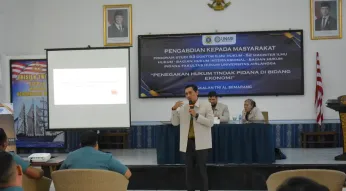
This was conveyed by Prof. Dr. Y. Sogar Simamora, S.H., M.Hum., Professor of FH UNAIR at a public lecture which was held on Wednesday (2/3/2022). The public lecture which was held by the Civil Law Section and the Center for Business Law Studies of FH UNAIR discussed the principles of contract law.
In addition to the principles, Prof. Sogar also discusses the sources of contract law and the legal terms of the contract. As previously stated regarding the definition of the term contract, the contract is one source of the birth of an engagement, where an engagement can be born from an agreement or statutory regulations.
Prof. Sogar explained that the sources of contract law can come from Burgerlijk Wetboek (BW) or the Civil Code, laws and regulations, as well as jurisprudence. One example of a contract originating from legislation is Law Number 2 of 2017 concerning Construction Services, while a contract originating from jurisprudence for example is Jurisprudence No. 3641 K/Pdt/2001 dated September 11, 2002 regarding Misuse of Circumstances.
The type of contract itself, he continued, consists of five types. The first type is named contract and unnamed contract, the second type is commercial contract and consumer contract, and the third type is private contract and public contract. In addition, there are also domestic contracts and international contracts, as well as executed contracts and execution contracts.
Contract law also has universal principles. According to Prof. Sogar, there are at least six principles that are included in the universal principles of contract law, including the principle of consensualism, the principle of freedom of contract, the principle of binding contractual power, the principle of privity of contract, the principle of good faith, and the principle of proportionality. All of these principles are regulated in the BW.
At the end, Prof. Sogar explained the terms of the validity of the agreement as stipulated in Article 1320 BW. The validity of an agreement must at least include subjective and objective conditions. If the four conditions are not met according to the provisions of Article 1320 BW, then the agreement is considered invalid.
Author : Goddess Yugi Arti